
BRICS 2026: The Rising Influence of China and India Outpaces Russia
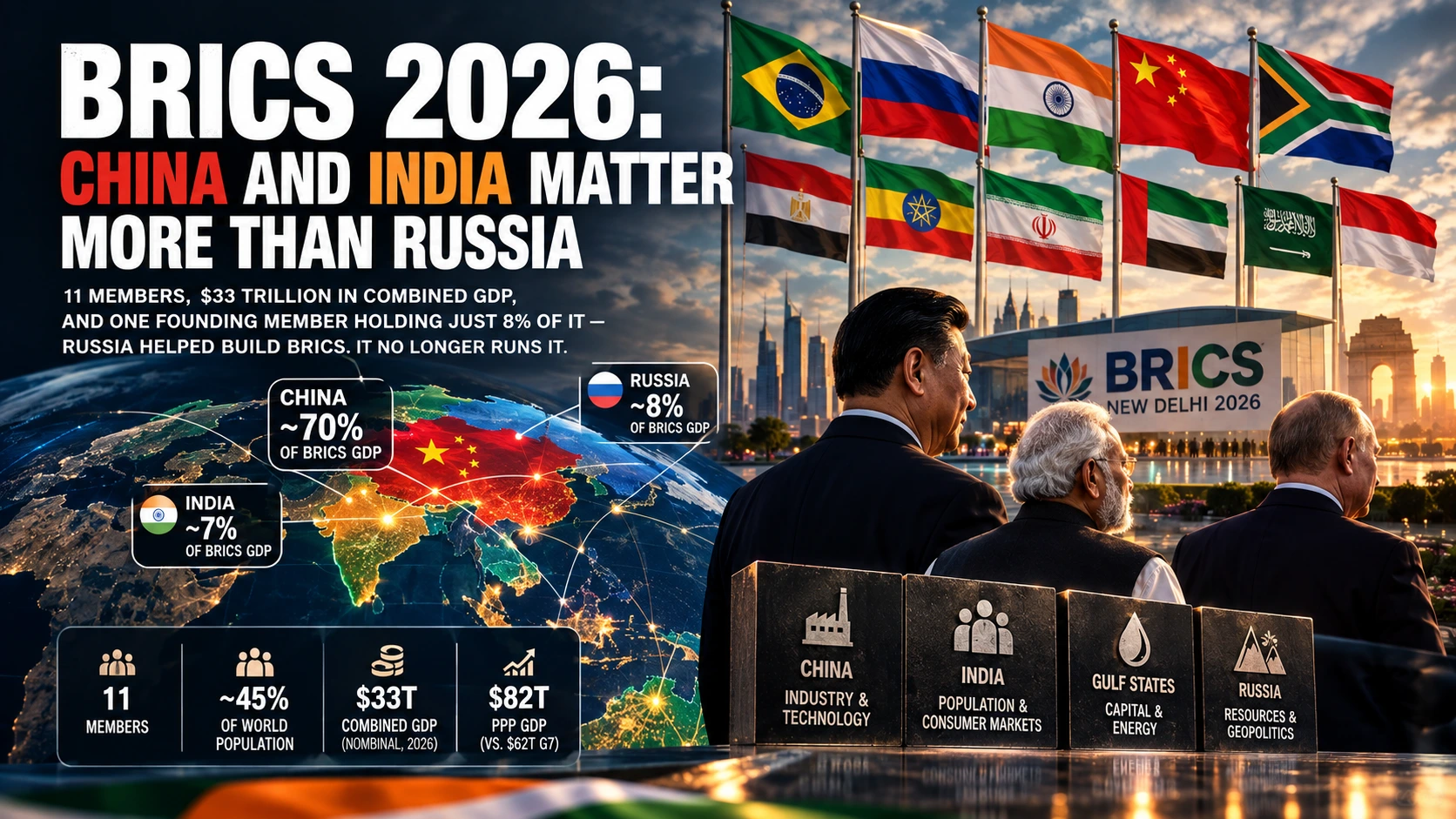
11 members, $33 trillion in combined GDP, and one founding member holding just 8% of it — Russia no longer runs it.
BRICS 2026 Summit and Membership Overview
On September 12–13, 2026, New Delhi will host the 18th BRICS summit. This event marks the organization's 20th anniversary and is notable as the first time an Indian-hosted summit has not alternated with either Russia or China in this timeframe, making it India’s fourth time chairing. BRICS currently counts 11 full members: Brazil, Russia, India, China, South Africa, Egypt, Ethiopia, Iran, the UAE, Saudi Arabia, and Indonesia. Collectively, the bloc represents approximately 45% of the world’s population.
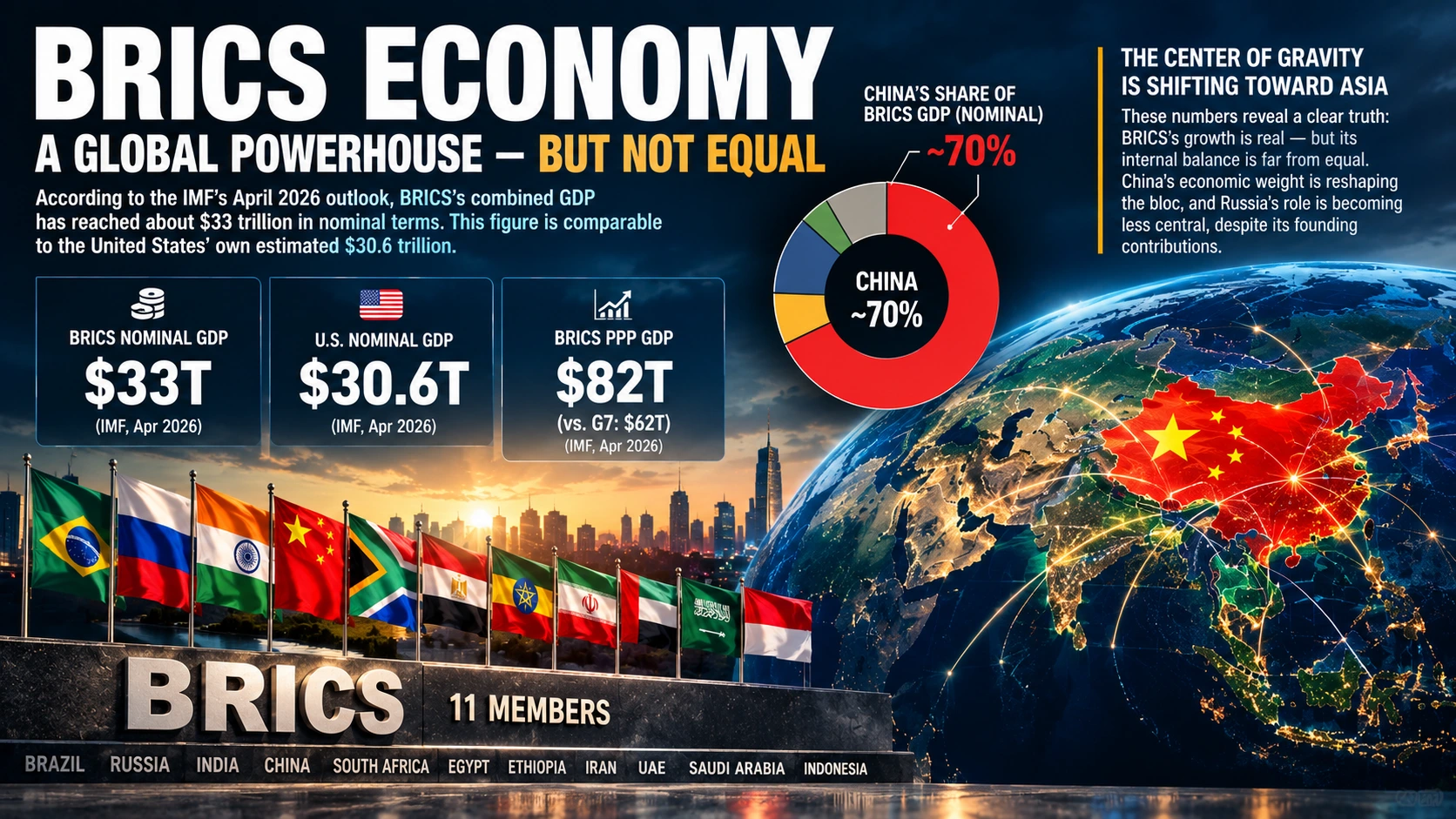
According to the IMF’s April 2026 outlook, BRICS’s combined GDP has reached about $33 trillion in nominal terms. This figure is comparable to the United States’ own estimated $30.6 trillion. On a purchasing-power-parity basis, the bloc's GDP reaches $82 trillion, overtaking the G7, which stands at $62 trillion. However, these aggregated numbers mask a highly uneven internal structure: China alone accounts for roughly 70% of the bloc's total GDP. This reality underscores a major structural shift for BRICS, as the bloc’s center of gravity moves toward Asia, reducing Russia’s pivotal role despite its founding contributions.
Russia’s Foundational Impact and Low Economic Role
Initially, Russia played an important role in turning BRICS from a Goldman Sachs economic acronym coined in 2001 into a full political platform. Moscow prioritized an agenda of de-dollarization, promotion of alternative payment mechanisms, and support for a multipolar world order, providing a real political contribution to the organization.
However, Russia does not serve as an economic engine for BRICS. Each major member fulfills a distinct role: China is the bloc’s industrial powerhouse and greatest trading economy, supplying machinery, electronics, and technology to other members. India contributes significant demographic and consumer weight as the world’s most populous country, a rapidly-growing major economy, and a leader in digital payment systems. Russia’s role is defined by resources and geopolitics, including energy, raw materials, nuclear technology, and diplomatic outreach, but not by industrial or demographic leadership.
In the long run, economic strength flows to those who combine population, productivity, and innovation.
China and India at the Center of the 2026 Summit
The primary focus of the New Delhi summit is the complex relationship between China and India. Both seek a more multipolar world order and a greater say in international institutions, yet remain strategic competitors. The 2020 border crisis sharply reduced political trust, while trade between the two countries has continued to increase, rising to about $155 billion in 2025 and growing further into 2026.
This dynamic—simultaneous competition for regional influence and growing economic interdependence—could have a larger impact on BRICS’s future direction than any initiative led by Russia. India has made it clear it does not intend to trade reliance on the West for dependence on China. Recent disagreements over proposed digital-payment integration highlight New Delhi’s specific concerns regarding Chinese payment infrastructure and data security. Notably, efforts by Russian state media to promote a China-Russia axis have been largely symbolic. India continues to prioritize its strategic autonomy instead of joining any such axis.
Russia’s Position Amid New BRICS Dynamics
With the accession of the Gulf states, particularly Saudi Arabia and the UAE, the economic structure of BRICS has become more complex than the familiar “Russia versus the West” narrative suggests. China and India now generate demand as the world’s largest consumer and labor markets. The Gulf states provide vital energy and capital, positioned at the crossroads of Asian energy demand and international investment.
In this arrangement, Russia’s role as a resource provider is no longer unique; it now overlaps with the capabilities of the Gulf members, who possess greater capital resources but do not match China’s or India’s demographic and industrial scale. Russia’s nominal GDP in 2026 stands at approximately $2.66 trillion, equal to roughly 8% of the bloc’s $33 trillion total—significantly outpaced by China’s estimated 70% share
Geopolitical Diversity and the Future of BRICS
India maintains a strategic partnership with the United States, while China is a strategic competitor to the US. Russia is openly hostile to much of the Western order, and the Gulf states have deep-seated economic and military relationships with the West. This diversity ensures there is no unified BRICS foreign policy and makes it unlikely that the bloc will ever become a cohesive anti-Western coalition.
The key future question is whether BRICS can function as an effective economic network despite persistent political disagreements among its varied members. What is clear is that BRICS’s demographic and industrial strength is increasingly concentrated in Asia. While Russia will remain an integral part of the bloc, its role will be that of a participant rather than a driver of its direction or destiny.