
Russia's Labour Market in Freefall
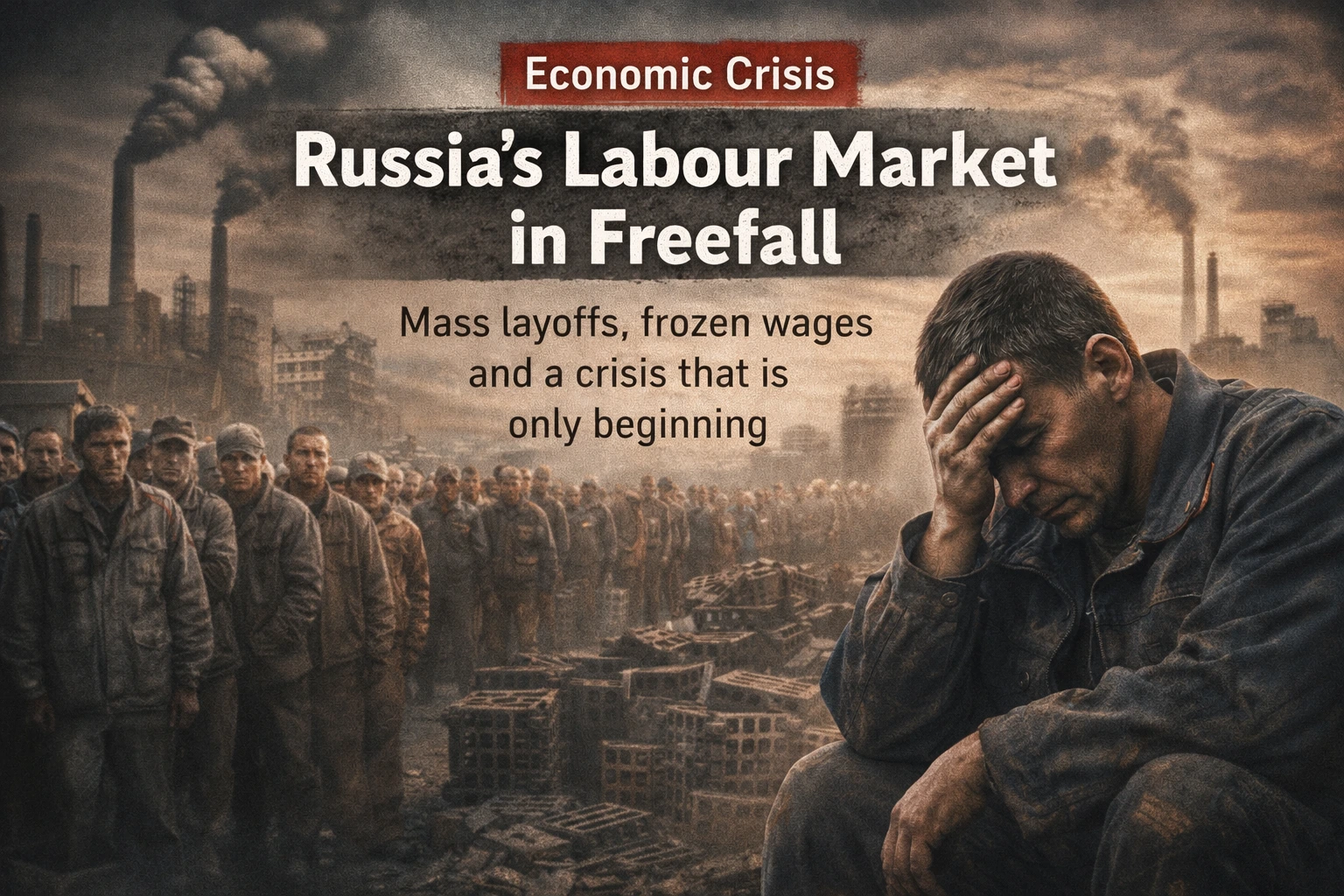
"The Institute of National Economic Forecasting estimates that returning to 2012 economic levels would require sustained growth of 3–5% annually for 15–25 years. Even in the best case, this is a decade-long project."
The factories are bleeding
Vladimir Baglaev, director of the Cherepovets Foundry and Mechanical Plant, does not speak in abstractions. He speaks in percentages — and the percentages are brutal.
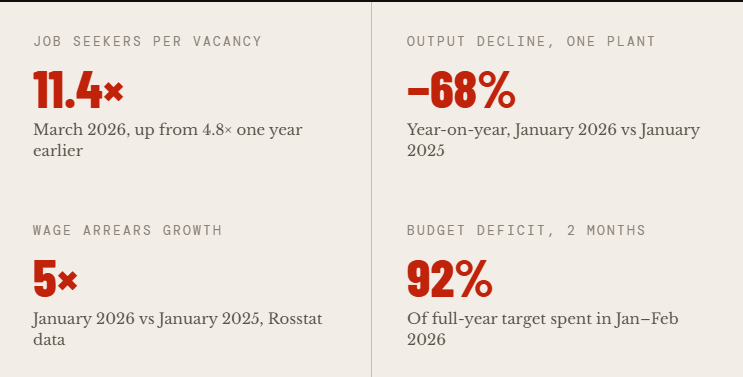
Year-on-year output at his plant fell 68% between January 2025 and January 2026. Not 2%. Not 10%. Sixty-eight percent. And that was not the worst figure he cited. Production of excavator-loaders — a key piece of construction and mining equipment — collapsed by 95% over the same period, even as the number of licensed manufacturers tripled.
"Three times more companies are producing the same machine. Twenty times less output. That kind of balance tends to discredit the word growth."
The picture he paints of the workforce is equally grim. Some plants in his network have cut headcount by more than half. Rosselmash, the agricultural machinery giant, reduced its workforce by 12.2% year-on-year. The Kirov Tractor Plant shed 22.6% of its staff. These are not startups. These are Soviet-era industrial anchors that have employed hundreds of workers for decades.
Sergei Serebryakov, director of the Kirov Plant group, says the real scale of the crisis is far larger than official statistics suggest. Companies are falsifying financial reports to prevent banks from calling in loans and to remain eligible for new working capital credit. The number of enterprises in de facto default on bank loans grew between seven and nine times in the past year. Not percentage points — times.
For the first time since the war began, the defence sector is no longer masking the collapse in civilian industry. The military-industrial complex has stopped compensating for the broader economic deterioration. As the Tsargrad channel put it bluntly: the defence sector used to pull the whole picture upward. Now even that is gone.
Wages withheld, hospitals gutted
The most politically dangerous indicator in any economy is unpaid wages. According to Rosstat, wage arrears in Russia grew five-fold year-on-year in January 2026, reaching 1.856 billion roubles. Construction accounted for 42% of that debt. Manufacturing followed at 31%. Mining came third.
More than 90% of all wage arrears accumulated in the last two years. The mechanism is straightforward and brutal: high interest rates make working capital credit expensive, debtor chains between companies grow longer, and when cash flow stalls, wages are the first obligation to be quietly skipped.
Healthcare system
Nurses in Kurgan lost 10,000 roubles per month in incentive pay without warning. Ambulance crews in Vladimir received January bonuses of 100 roubles — not 100,000, not 10,000. One hundred roubles. In Tuva, maternity ward staff received advance pay of 7,000 roubles as the hospital used the rest to service its debts. Teams of nurses across multiple regions have filed collective resignation notices.
The retail sector tells the same story. For the first time in the 21st century, the number of retail outlets in Russia declined in 2025. Moscow alone lost 4,500 shops. St. Petersburg lost 3,000. The government's response — raising taxes on small business — produced the opposite of the intended effect. The Finance Ministry did not collect more tax revenue. It collected less, as closures accelerated and the taxable base shrank.
The structural picture: an economy that stopped investing
Capital investment in Russia fell 2.3% in 2025 — the first decline since the pandemic year of 2020 and the sharpest since 2015. In the fourth quarter the drop accelerated to 5.3%. Russian companies are not investing because they cannot afford to borrow, because demand is weak, because sanctions make equipment hard to source, and because the risk-reward calculation of building anything for the long term has turned deeply unfavourable.
Railway freight loading — historically one of the most reliable proxies for real economic activity — is forecast to fall 4% in 2026 to its lowest level since 2001. Coal loading alone is expected to decline by 17 million tonnes. Sixty-two Russian coal producers are currently loss-making. Twenty have suspended operations. Fourteen have moved toward conservation or liquidation. Total industry debt has exceeded 1.5 trillion roubles.
The budget deficit tells the same story from a different angle. In the first two months of 2026 alone, Russia burned through 3.5 trillion roubles in deficit spending — equivalent to 92% of the entire annual deficit target of 3.786 trillion roubles. In sixty days, the government spent nearly what it had budgeted to lose over twelve months. Sequester plans are reportedly in preparation: minus 10% across non-military, non-social spending, with up to minus 25% on selected discretionary items.
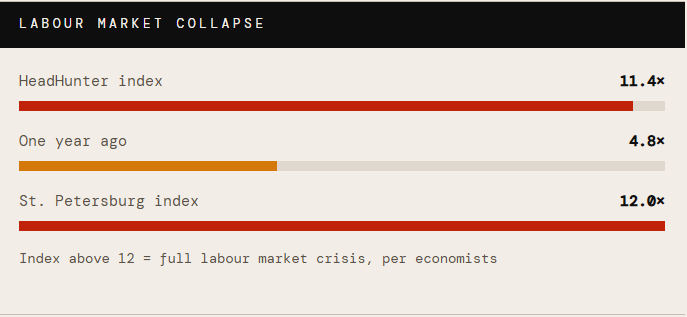
The Centre for Macroeconomic Analysis warns that risks of a prolonged recession extending through January 2027 cannot be excluded. Problematic assets in the banking sector have already exceeded 10% of total assets. With the key rate still at 15% after only cautious reductions, the investment pause is structural, not cyclical. Russia's leading economist at VEB flagged as early as August 2025 that the economy had contracted for two consecutive quarters — a technical recession by any standard definition.
Market Panic and Multi-Year Lows
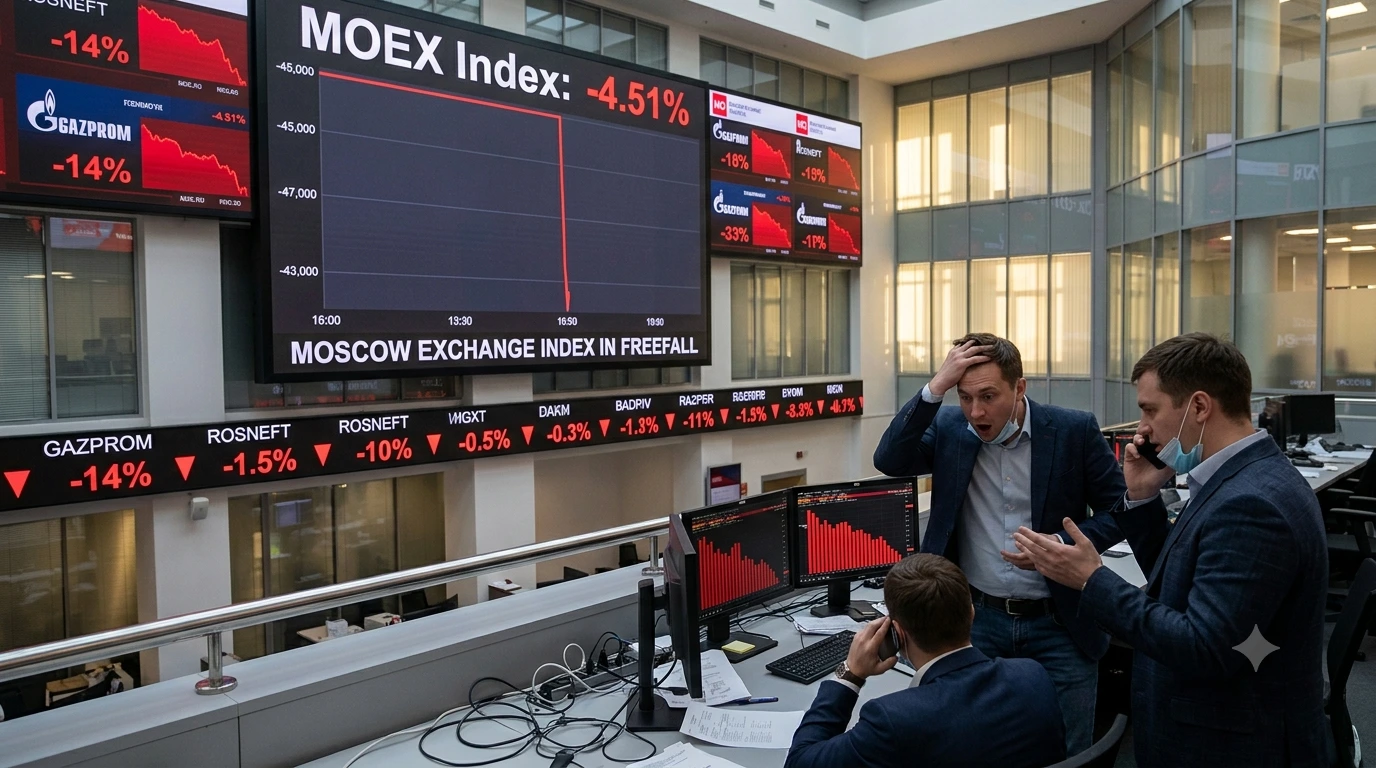
Real panic erupted on the Moscow Exchange (MOEX) in late June, triggering a massive sell-off that dragged the index down by over 4.5% in a single day**, wiping out years of growth and hitting its lowest level since early 2023. The market’s traditional anchor, Gazprom, saw its shares plummet below the psychological 100-rouble threshold for the first time since the 2009 financial crisis, while Rosneft suffered its sharpest single-day collapse since the 2022 mobilization announcement. This wave of panic among investors ultimately confirmed that the civilian industrial contraction, combined with the Central Bank’s refusal to lower suffocating interest rates, has broken the market’s capacity to recover.