
The GTA Index: 13 Years of Stagnation in Five Percentage Points
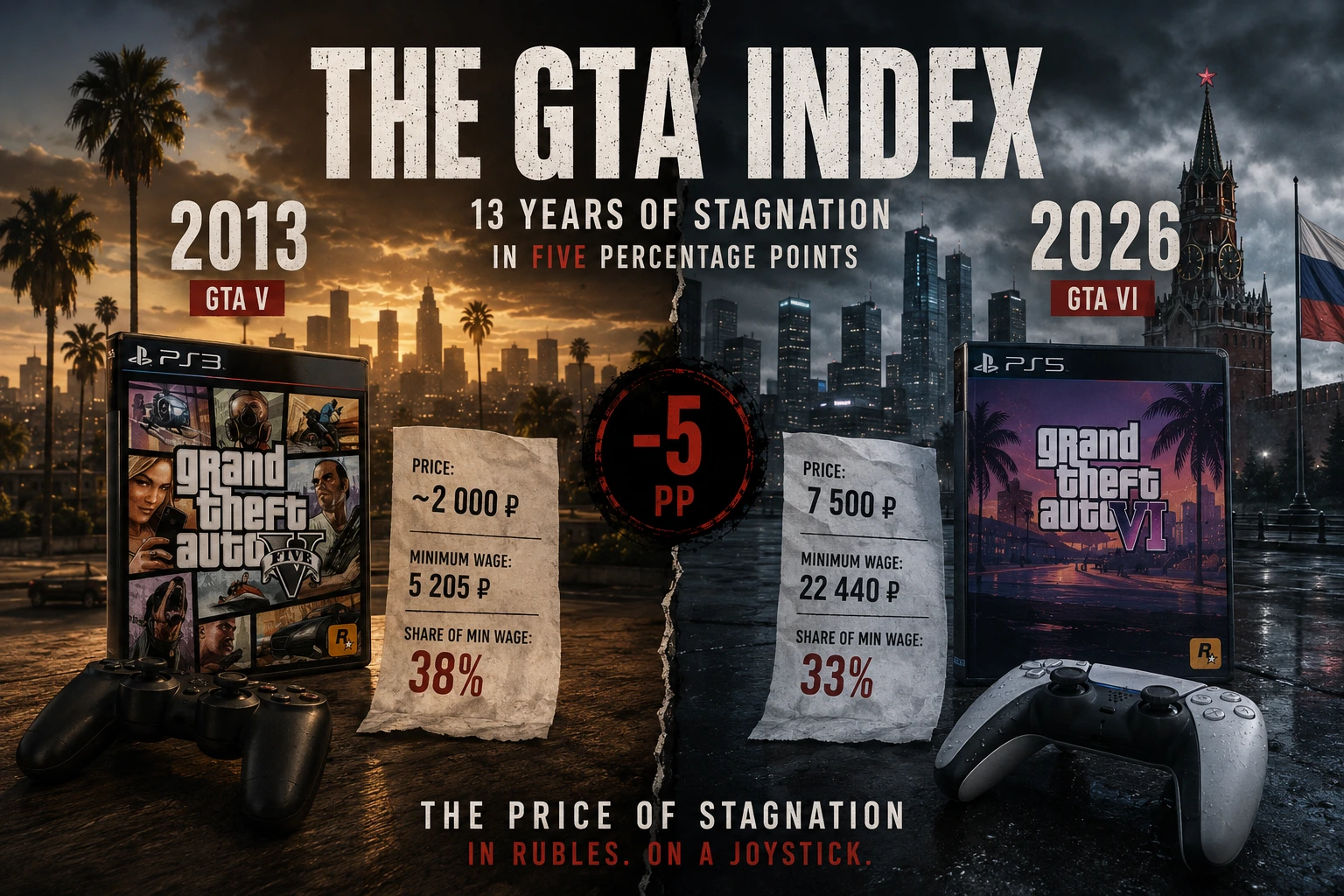
The bottom line: GTA V in 2013 cost 38% of Russia's minimum monthly wage. GTA VI in 2026 costs 33%. In thirteen years, the Russian minimum-wage worker gained seven working hours on a single video game. That is the price of stagnation — measured not in GDP percentages, but in time.
From 38% to 33%: the numbers that look like progress — and what they actually reveal
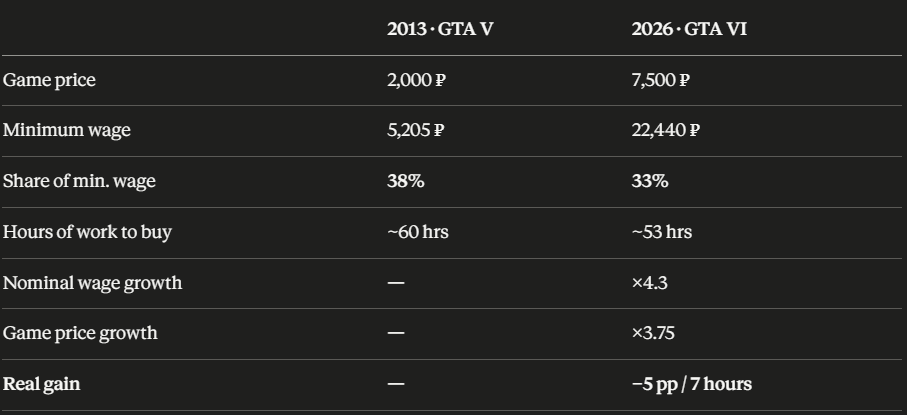
If you look only at the figures, it resembles progress. In 2013, GTA V cost roughly 38% of Russia's minimum monthly wage. In 2026, GTA VI costs roughly 33%. The difference exists — but it is negligible: five percentage points over thirteen years. The minimum wage rose 4.3 times in nominal terms. The game price rose 3.75 times. Technically, wages won. Technically.
The problem is that "technically" is doing a great deal of work in that sentence. Nominal wages rising faster than one specific consumer goods price tells you almost nothing about whether people's lives actually improved. To answer that question, you need to look at what happened to real purchasing power — and that is where the story changes entirely.
Official cumulative inflation in Russia between 2013 and 2026 exceeded 100%. Swedish Military Intelligence, in an assessment published in April 2026, estimated real Russian inflation at approximately 15% in 2025 alone — nearly three times the official Rosstat figure. The Central Bank of Russia's own consumer surveys show that Russians themselves report price growth of around 14–15% annually, consistently, year after year. When a country's citizens observe inflation at three times the official rate, and when an independent foreign intelligence service reaches the same conclusion, the official statistics are the outlier — not the confirmation.
This means the nominal 4.3x growth in the minimum wage dissolves almost entirely in real terms. The five percentage points of GTA Index improvement are not evidence of rising living standards. They are evidence that wages and prices ran almost exactly the same race — and wages edged ahead by a margin too small to feel.
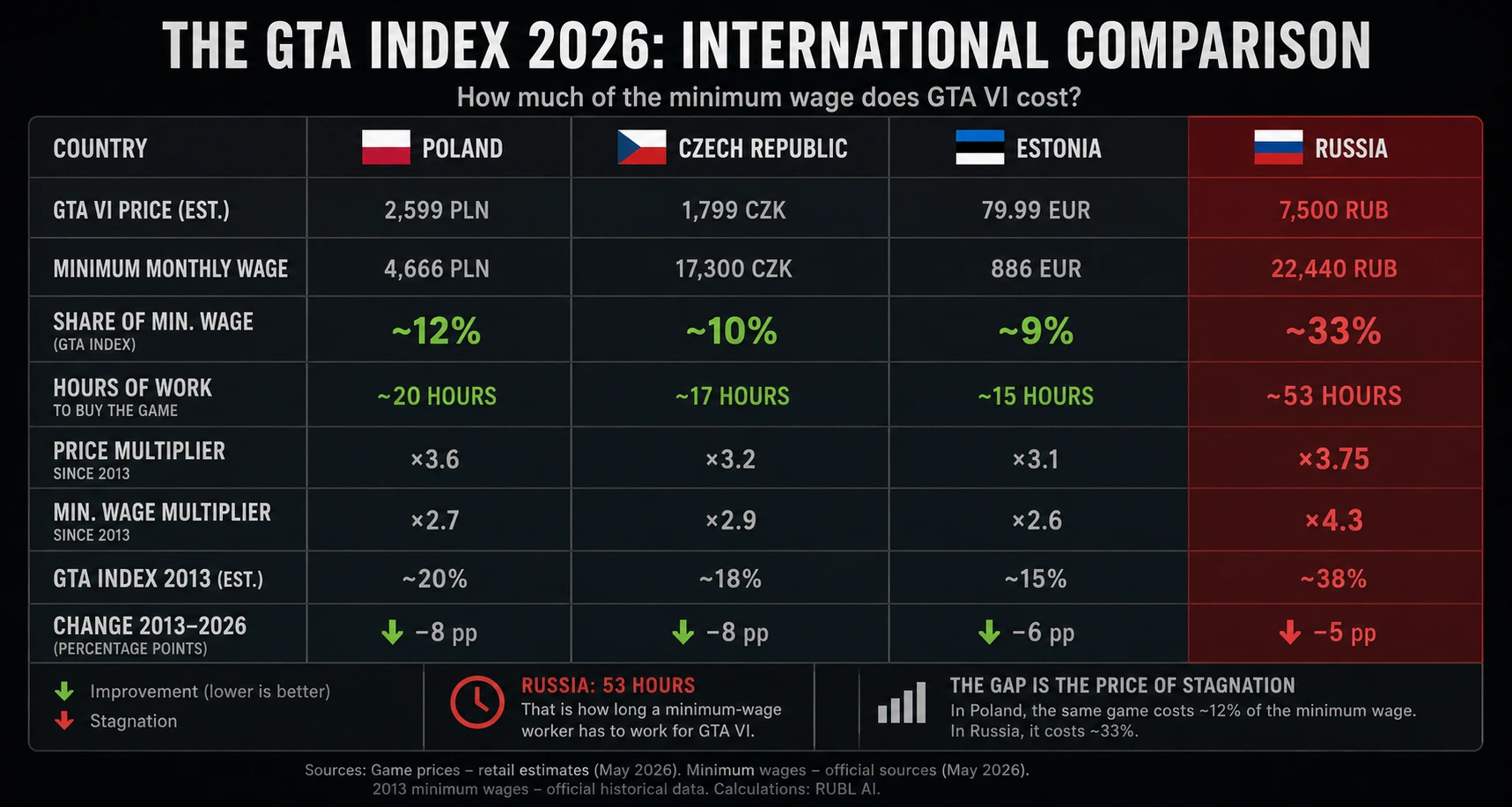
The comparison that puts this in sharpest relief is not with Russia's own past, but with its neighbours. In Poland, GTA VI in 2026 costs approximately 12% of the minimum monthly wage. In Estonia, around 9%. In the Czech Republic, around 10%. These are not wealthy Nordic countries — they are former communist economies that started from roughly comparable positions in the early 1990s. The gap between 12% and 33% is not a rounding error. It is the accumulated result of thirty years of different choices.
⚡ The number that concentrates the mind: 7 hours. That is the total gain across thirteen years. Less than thirty minutes per year. In Poland, the equivalent gain over the same period was roughly 25–30 percentage points.
➡️ Insight: Five percentage points in thirteen years is not the trajectory of a developing economy. It is the symptom of an economy that knows how to stay afloat — but has forgotten how to move forward.
The same price, a completely different world: why 33% in 2026 weighs more than 38% in 2013
The raw percentage comparison understates the real deterioration — because it treats 38% in 2013 and 33% in 2026 as if they exist in the same economic and psychological context. They do not.
In 2013, Russia was a country where oil traded above $100 a barrel, where real incomes had been rising for a decade, where there were no Western sanctions, and where some version of integration with the global economy still seemed like a realistic long-term trajectory. A person on minimum wage saving for GTA V was doing so in an environment of cautious optimism — or at least of forward momentum. The sacrifice of forty percent of a monthly paycheque felt meaningful precisely because it was a sacrifice: you bought it because it mattered, you played it because you had committed to it, and the purchase itself signalled that you had made room for something in your life.
In 2026, the context is unrecognisable. Official recession has been confirmed, with industrial output falling for the second consecutive month. The manufacturing sector — the core of any industrial economy — contracted 2.8% in the first two months of the year. Wage arrears grew five-fold year-on-year in January 2026. The HeadHunter job-seeker-to-vacancy ratio reached 11.4 in March — up from 4.8 just one year earlier. In St. Petersburg, it exceeded 12, a level economists classify as full-scale labour market crisis. Some factories have cut headcount by more than half. Seventy percent of small and medium businesses reported near-term bankruptcy risk in a survey of 14,000 enterprises. The federal budget burned through 92% of its annual deficit target in the first two months of the year.
In this environment, a person on minimum wage spending 33% of their monthly income on a video game is not making a joyful discretionary purchase against a backdrop of steady improvement. They are making a considered luxury expenditure against a backdrop of genuine economic anxiety — wondering whether their employer will delay the next payroll, whether the factory will still be running in six months, whether the roubles they are handing over today will buy meaningfully less tomorrow.
The psychological accounting:
In 2013: 38% of minimum wage, spent with the feeling that tomorrow would be better.
In 2026: 33% of minimum wage, spent with background anxiety about whether there will be a job tomorrow.
The percentage fell. The weight of the decision grew.
The GTA Index measures the financial cost of the purchase. It cannot measure the emotional context in which the purchase is made. But that context matters — and in Russia between 2013 and 2026, it shifted from cautious optimism to structural anxiety. The five percentage points of improvement were more than offset by the deterioration in everything the index does not capture: job security, income stability, confidence in the future, the basic sense that the economy is moving in the right direction.
This is what stagnation feels like from the inside. Not catastrophe — catastrophe would at least be dramatic. Stagnation feels like approximately the same percentage of your wages going to approximately the same category of purchase, year after year, while the world around you changes in ways that all seem to make things harder. The number barely moved. Everything else did.
The diagnosis: thirteen years, one economic model, and the cost of the road not taken
Russia's failure to close the GTA gap is not accidental and it is not explained by geography or culture. It is the direct consequence of a series of specific economic and political choices — most of which had been identified as problems long before they became crises.
The first and most fundamental is commodity dependency. Russia spent the 2000s and early 2010s — years of extraordinarily high oil revenues — largely failing to diversify the economic base. The windfall was consumed rather than invested in the structural transformation that would have allowed real wages to rise sustainably. When oil prices fell sharply in 2014–2015 and sanctions followed the annexation of Crimea, there was no diversified industrial base to absorb the shock. The economy contracted, real incomes fell, and they never fully recovered the trajectory they had been on before.
The second is the investment collapse. Capital investment in fixed assets fell 2.3% in 2025 — the first decline since the 2020 pandemic and the sharpest in a decade. The quarterly trajectory tells the story: down 4.3% in the third quarter, down 5.3% in the fourth. Companies have stopped investing because the key interest rate reached 21%, making any capital project economically irrational for any business that relies on borrowing. When companies stop investing, productivity stops growing. When productivity stops growing, real wages stop growing.
When real wages stop growing, the GTA Index stops improving.
The third is the war. By realistic budget estimates, military expenditure now consumes approximately half of Russia's federal budget — far above the official figure of around 30%, which excludes construction, IT services and military social security. This is not money available for the education, infrastructure, healthcare and industrial investment that would make Russian workers more productive and Russian wages more competitive. The Institute of National Economic Forecasting estimates that returning to 2012 peak economic levels — not 2021 levels, but 2012 — would require sustained annual growth of 3–5% for fifteen to twenty-five years. That is not a recovery plan. That is a description of the distance between where Russia is and where it could have been.
The counterfactual that matters:
If Russia had developed at Poland's pace between 2013 and 2026, GTA VI would cost a minimum-wage worker roughly 15–18% of monthly income today — instead of 33%. If it had matched Estonia, the figure would be closer to 9%. The gap between those numbers and 33% is not fate. It is the accumulated consequence of the commodity trap, the investment collapse, the sanctions, and the war — each compounding the others, each pushing the GTA Index in the wrong direction.
The Polish minimum-wage worker in 2026 works approximately 19 hours to afford GTA VI. The Russian minimum-wage worker works approximately 53 hours. That 34-hour gap is thirteen years of divergent economic trajectories, compressed into a single purchase decision on a Tuesday afternoon.
What makes the GTA Index a useful diagnostic tool is precisely its simplicity. It cuts through the noise of official GDP statistics — which Swedish and German intelligence have both concluded are systematically falsified upward — and asks the most basic question in economics: how long do you have to work to buy one normal thing? The answer in Russia is: about the same as in 2013. Which means that for all the nominal growth, all the rouble figures that went up, all the announcements about sovereign development and economic resilience — the minimum-wage worker's relationship with the basic economics of cultural consumption has barely changed in thirteen years.
That is stagnation. Not recession, not collapse, not crisis — just the quiet accumulation of years in which almost nothing improved for the people at the bottom of the wage distribution, while almost everything was explained away by statistics that told a different story.