
Grain Crisis in Russia: Logistics Breakdown and Unprofitable Prices Threaten Farming Sector
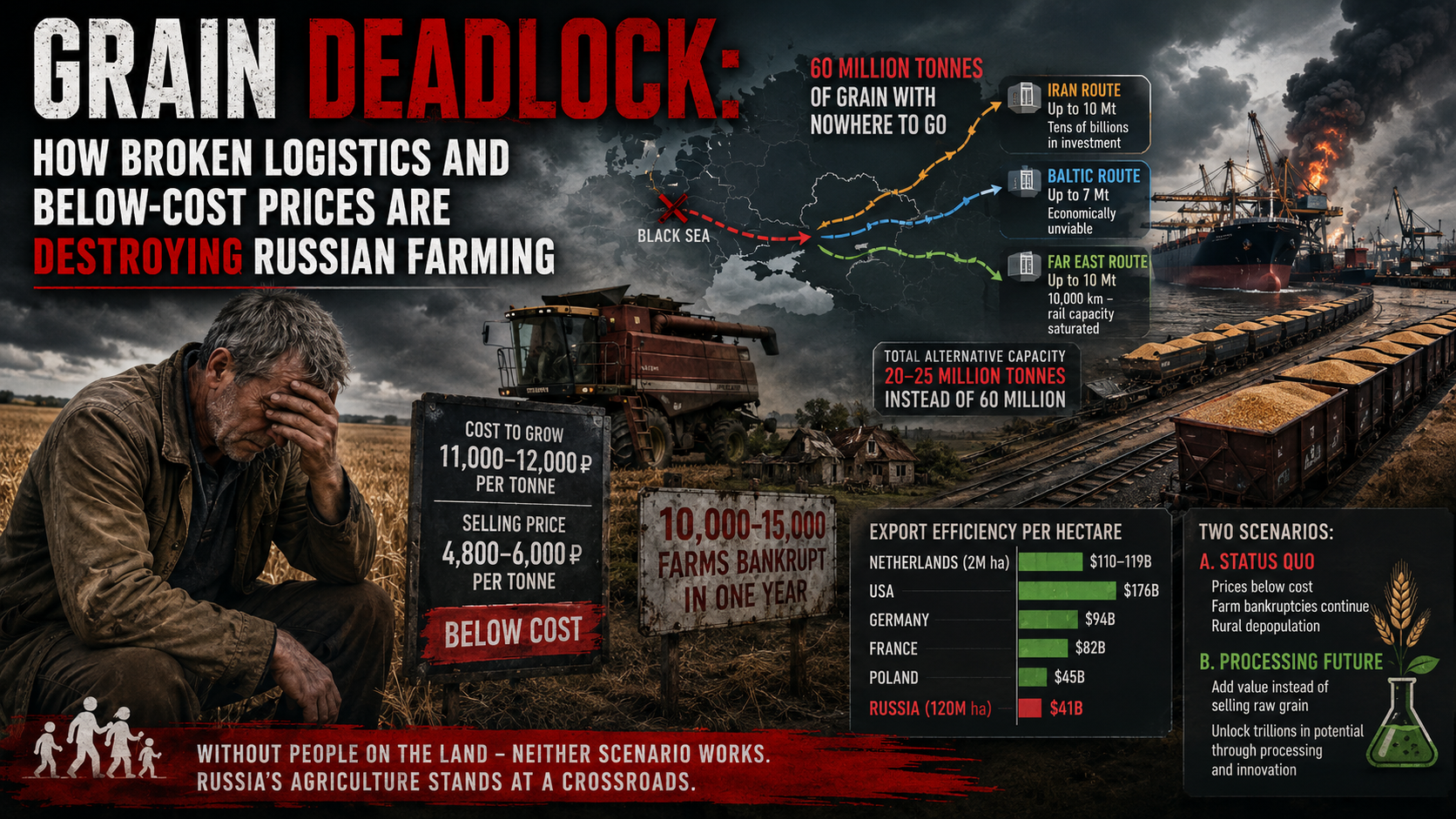
Russian farmers are facing a systemic crisis as grain prices fall far below production costs, with broken logistics and closed export routes compounding industry losses and widespread bankruptcies.
Economic Losses Deepen for Russian Farmers
The cost of producing a tonne of wheat in regions such as Rostov or Kurgan stands at 11,000–12,000 rubles, but current market prices have dropped to between 4,800 and 6,000 rubles per tonne—less than half the cost of production. This severe divergence is not limited to a single region but reflects a crisis extending across the country. Independent industry data from early July 2026 show that the price for grade-4 food wheat at deep-water Black Sea ports fell to 14,800–15,000 rubles per tonne excluding VAT. In southern regions and areas of Siberia and the Urals, prices sink even lower, often reaching or undercutting the cost of production.
For farmers, these numbers are not just statistics—they are matters of survival. Obligations such as taxes, loans, payments to suppliers, and payroll were budgeted on profitability assumptions that have now evaporated. Farmers who invested in new equipment after 2014–2015 have consistently recorded losses since 2022, leading to mass repossessions by Rosagroleasing and banks due to missed payments. A presidential order to defer loan payments came too late: by its issuance, 10,000–15,000 farms had already closed. Direct bankruptcies are also rising, including major grain traders, as evidenced by an August 2026 filing in Voronezh involving a firm with revenues exceeding 3 billion rubles. The underlying issue is not a failed harvest, but the inability to sell grain at a price that covers costs, making this a crisis of sales, not yields.
Logistics Paralysis Leaves Millions of Tonnes Unsold
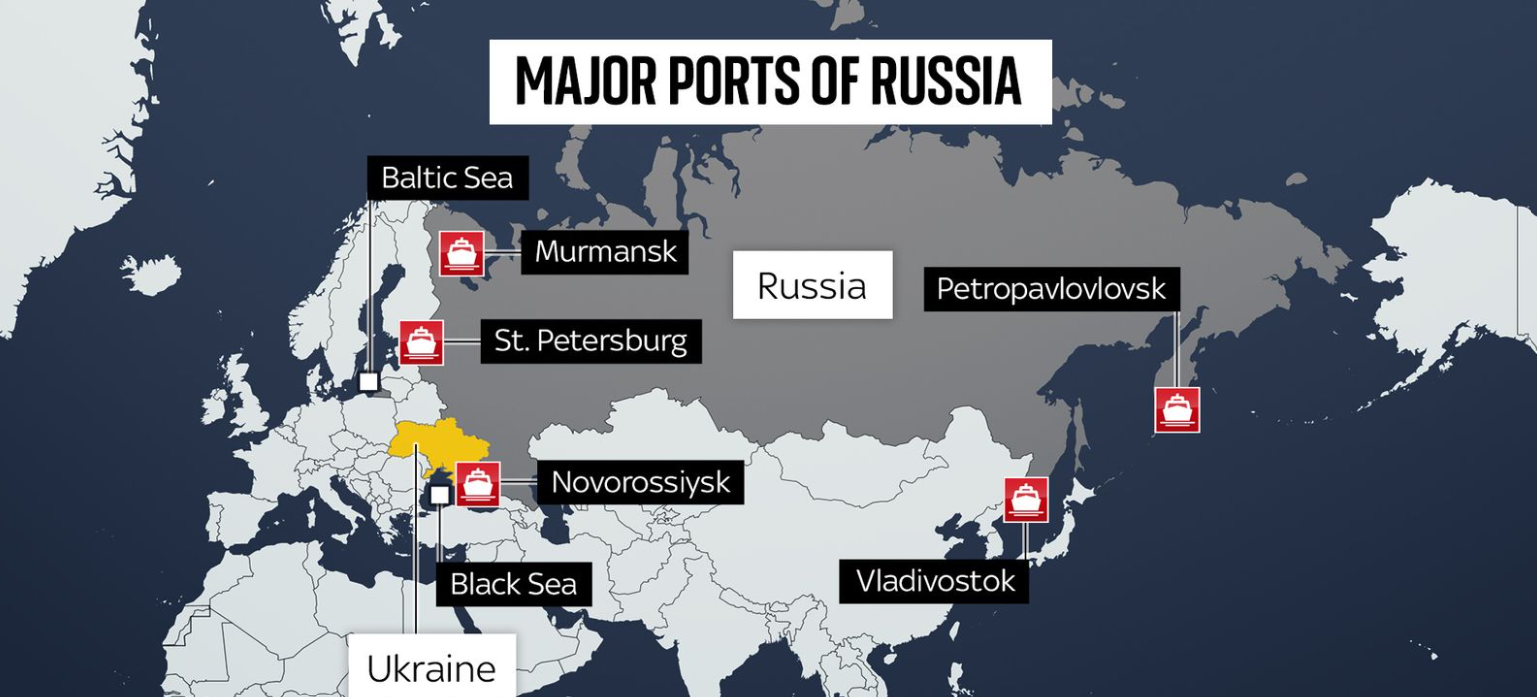
Collapsing grain prices are rooted not in overproduction but in severely restricted export channels. Of a planned 60 million tonnes of grain meant for export, the main route—the Black Sea corridor, which previously handled roughly 70% of exports—is now largely shut down due to attacks on port infrastructure. This closure has left vast amounts of grain with no viable path to foreign buyers.
Alternative export routes exist mainly in theory. The Iranian corridor would require tens of billions of rubles in investment—with estimates of 30 billion into one port and 20 billion into another—but even this would limit throughput to just 10 million tonnes annually. The Baltic route, diminished by the closure of transit through the Baltic states, could accommodate a maximum of 7 million tonnes using domestic ports such as Vysotsk after all proposed upgrades; however, the distances involved make this route economically nonviable. The Far Eastern corridor, though available, involves a journey of up to 10,000 km to Vladivostok or Nakhodka, where rail lines are already congested with coal shipments, further restricting grain movement.
Combined, these alternatives could move only 20–25 million tonnes, far short of the 60 million tonnes originally intended for export. The residue remains unsellable, which is why domestic grain prices have collapsed while global grain markets remain unaffected, as other major exporters increase their supply. Even anticipated demand from China is limited, as China has increased its own production by 50 million tonnes and cannot absorb more than 3–5 million tonnes of Russian wheat.
Global Exports and Russia’s Competitive Disadvantage
The strategic weaknesses in Russia’s agricultural logistics have become starkly evident when contrasted with export efficiencies achieved by other countries. Russia, with 120 million hectares of farmland, exports $41 billion in agricultural products. By comparison, the US exports $176 billion; the Netherlands, with only 2 million hectares, exports between $110 billion and $119 billion; Germany exports $94 billion, France $82 billion, and Poland, despite considerably less territory, exports $45 billion—outperforming Russia.
This discrepancy does not stem from inferior yields or lack of land but instead reflects deficiencies in processing capabilities, logistical infrastructure, and the creation of added value throughout the production chain. Without adequate logistics and investment in value-added processing, Russian grain remains at a significant disadvantage.
Possible Scenarios: Continuation or Transformation
Industry analysts outline two principal scenarios for the future of Russia’s agricultural sector. The first, Scenario A, assumes the current status quo persists: export routes remain blocked, grain is sold below production cost, bankruptcies proliferate, and populations continue to decline in rural areas. Under this trajectory, the narrative of Russia as an agricultural superpower increasingly diverges from the actual economic realities faced by its farming sector.
Scenario B focuses on transformation through investment in processing rather than the export of unprocessed, low-grade grain. For example, converting 60 million tonnes of grain that would otherwise be sold as raw commodity at $220 per tonne into protein-vitamin feed additives could raise its market value to $1,000 per tonne. There is also significant untapped potential in processing Sosnowsky's hogweed, which yields up to 150–250 tonnes of green mass per hectare with 17–30% sugar content. The estimated industrial processing potential from this plant reaches up to 7 trillion rubles, nearly matching the country’s total current agricultural output of about 10 trillion rubles. Additional growth could come from industrial-scale cultivation of medicinal and aromatic plants for pharmaceuticals.
Both scenarios depend on the same physical resources: land, harvest, and climate. The decisive factor will be whether capital is invested in logistics and processing or remains tied to exporting raw commodities for minimal returns under restricted export conditions.

Demographic and Social Challenges in Rural Russia
The pressing economic and logistical challenges are paralleled by persistent demographic decline in rural areas. The ongoing policy of shrinking rural settlements has led to population loss in agricultural regions, a trend that undermines both potential recovery scenarios. Without a stable and sufficient rural population, neither continued raw commodity export nor a transition to value-added processing and logistics investments will be sustainable.
The fate of Russia's agricultural sector thus hinges not only on macroeconomic and structural reforms but also on reversing the exodus from rural territories, ensuring that both human and capital resources are available to sustain its long-term viability.